
Expert Tips to Create the Lush, Green Yard of Your Dreams
Blog Overview:
- Fertilization should be complemented. Mowing, watering, and soil testing enhance your lawn care results.
- Pay attention to your grass type. Warm-season grasses in Florida (Bermuda, Zoysia, St. Augustine) need the most attention in the window between late spring and early fall.
- Timing is the most important factor. Soil temperature is the most accurate way to determine when to fertilize your lawn.
- You can overfertilize. Using too much fertilizer will burn the grass, build up thatch, and create runoff.
- Homeowners in Tampa, Hudson, and New Port Richey should contact Your Green Team for expert fertilization and lawn care!
Base Your Lawn Fertilizer Schedule on Soil Temperature
Grass roots begin drawing in nutrients when soil temperature reaches around 65°F. Fertilizer applied to the lawn below that temperature either breaks down without being absorbed or washes away with the next rain.
For the warm-season varieties in Florida lawns, like St. Augustine, Bermuda, and Zoysia, the productive feeding range is higher, between 70 and 85°F. That’s when these grasses are actively growing and hungry for nutrients.
A soil thermometer costs a few dollars and takes seconds to use. Push it into the ground, read it, and you have actual information instead of a calendar-based guess. Most Florida homeowners who try this once realize their sense about fertilizer timing runs several weeks ahead of when the soil is ready.
Don’t want to use the thermometer? The lawn tells you the same thing. When grass shifts from its dull winter appearance to actively green and ready to be mowed, conditions are right.
What Makes Fertilizer Effective?
Fertilizer delivers a combination of three core nutrients. Understanding what each one does helps explain why timing and rate matter so much:
- Nitrogen is responsible for the visible results of blade growth and the deep, consistent green that signals a healthy lawn.
- Phosphorus works at the root level, supporting the development and energy transfer that keeps grass resilient through Florida’s summer heat and periodic drought.
- Potassium is the long-game nutrient that builds cell wall strength and disease resistance.
When all three are available in the right proportions at the right moment, the results multiply. Turf density increases, color becomes more uniform, and the lawn builds enough competitive strength to crowd out weeds without intervention.
It’s important to keep in mind that more fertilizer doesn’t produce more of these benefits.
Heavy nitrogen applied at the wrong time burns grass within days. Product applied before a significant Florida rainstorm washes straight into storm drains before the soil absorbs anything. And pushing rapid growth during heat stress produces grass that looks lush briefly and then crashes and invites disease in afterward.
How Often Does a Florida Lawn Need Fertilizing?
The short answer is two to four times a year, but where your lawn falls in that range depends on a few factors.
Your Soil
Sandy soils that are common in coastal and central areas don’t retain nutrients well, so they benefit from more frequent, lighter applications. Heavier clay soils hold nutrients longer but can develop compaction and drainage issues. These limit how effectively those nutrients reach grass roots. Knowing which you’re working with shapes the frequency question significantly.
The Fertilizer
Slow-release granular formulas break down gradually over six to eight weeks, feeding the lawn steadily. They’re more forgiving on timing and application rate.
Quick-release fertilizers work faster but deplete faster and leave less margin for error. For most Florida homeowners running a seasonal program, slow-release is the lower-risk choice.
Your Grass
St. Augustine, Bermuda, and Zoysia have extended active growing periods in Florida’s climate compared to the same grasses in states further north. That longer window creates more feeding opportunities throughout the summer.
Florida Seasonal Fertilizer Schedule
Early Spring
As soil temperatures climb toward 65°F and the lawn begins to wake up, a conservative early spring application supports root recovery coming out of dormancy. Too much nitrogen in early spring pushes blade growth before the root system is ready to support it.
If soil is still cold or the grass clearly hasn’t broken dormancy, skip this application. Fertilizing grass that isn’t actively growing accomplishes nothing.
Late Spring
Five to eight weeks after the early spring application, a late spring feeding lands during Florida’s most aggressive warm-season growth period. This is when St. Augustine and Bermuda are filling in bare spots, building density, and competing most actively against warm-season weeds.
Nitrogen-focused fertilizer drives the visible growth response. This is also the best window to use a combined fertilizer and pre-emergent weed control product if dollarweed, crabgrass, or other annuals have been persistent problems.
Summer
Florida’s summer heat puts warm-season grass under real stress. The goal of summer fertilization is to maintain what the lawn has already built. A light slow-release application keeps nutrients available at a steady rate without triggering the quick growth that heat stress can turn into disease or decline.
Fall
This is the most strategically important feeding of the year. Warm-season grasses in fall are storing carbohydrates and building the root reserves that carry them through colder weather. A well-timed fall application directly fuels that underground process.
Apply while soil temperatures are still in the productive range. In much of Florida, that window extends later into the season than in other Southern states. Just be sure to stop before any cold snaps arrive because late nitrogen applications stimulate growth that cool temperatures will damage.
Fertilization Mistakes Florida Homeowners Make
- Starting too early in the season. Late February feels warm in Florida, but the soil usually hasn’t caught up yet. Two minutes with a soil thermometer eliminates this mistake completely.
- Overapplying quick-release nitrogen. Burn appears as yellowing or browning within days of application. Consistently under-feeding produces better lawns than occasionally over-feeding.
- Applying before rain. Light rain after an application is fine. A Florida afternoon thunderstorm arriving hours after you spread fertilizer washes product into storm drains before the soil absorbs any of it. Check the hourly forecast before you start.
- Feeding the wrong grass at the wrong time. Knowing your grass type shapes every decision that follows.
Tips for Proper Application
How you spread fertilizer matters as much as what you spread. A few habits that make a consistent difference:
Mow one to two days before applying so granules reach the soil surface rather than sitting on top of the grass.
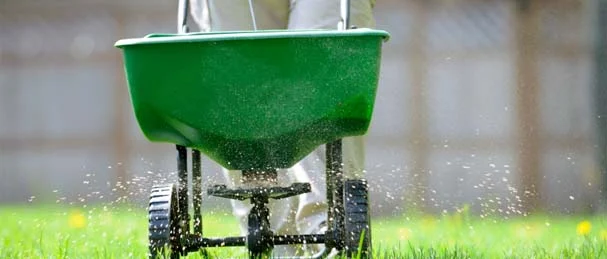
Choose your spreader based on the area. Broadcast spreaders cover large open lawns efficiently, while drop spreaders give you the precision you need near garden beds, pool areas, or property edges where overspray causes problems.
Overlap your passes slightly. Skipped strips become visible within a week as faint lighter-green lines through an otherwise even lawn.
After spreading, water lightly to carry granules off the blades and into the soil.
Sweep any product off driveways and sidewalks before watering. Anything on a hard surface heads straight for the storm drain when it rains.
3 Ways to Maximize Your Fertilization
Leave the clippings
A mulching mower returns nitrogen to the soil after every mow throughout the growing season. It’s a background fertilizer application that requires zero extra effort and costs nothing beyond the mower attachment.
Change how you water
Shift to deep, infrequent watering. Those longer sessions spread over fewer days build root depth that pulls from a much larger area. The result is that the same fertilizer application goes noticeably further.
Soil test regularly
Every two to three years, a basic soil test reveals the actual pH, nutrient levels, and organic matter content of your lawn. A test turns a generic seasonal schedule into one built around what your specific yard actually needs.
Change Your Approach Based on Lawn Age
Starting from seed or sod?
Apply a starter fertilizer at or just before seeding. Starter formulas are phosphorus-heavy, helping new grass roots establish. With new sod, give the roots two to three weeks to begin anchoring into the soil before applying any fertilizer.
Keep weed control products entirely off new lawns until the grass is established. Pre-emergent herbicides prevent the germination of your grass seed. Post-emergent products stress young turf enough to meaningfully set back establishment.
Already have established turf?
Follow the seasonal schedule and let the lawn’s actual performance guide adjustments. A lawn that greened up quickly and filled in evenly after the last application may need slightly less next time. One that recovered slowly or showed patchy results is pointing toward a soil condition worth investigating.
Fertilizer Questions Homeowners Ask
-
Can you put down too much fertilizer?
Yes. Burned turf, accelerated thatch buildup, and nutrient runoff into Florida’s waterways are all real consequences of overapplication.
-
Apply fertilizer before or after rain?
Always apply to dry grass and water lightly afterward.
-
The lawn looks green already. Does it still need fertilizing?
Color tells you one thing about lawn health. Growth rate, density, and how the grass holds up under foot traffic and summer stress tell you more.
-
What's the best month for Florida?
For St. Augustine, Bermuda, and Zoysia across the Tampa Bay area and surrounding communities, late May and early September represent the two highest-return windows.
Get a Professional Fertilizer Program
Executing a seasonal fertilization program takes more sustained attention than most homeowners want to give it. When one variable is off, whether timing, rate, or product selection, the results land somewhere between okay and disappointing.
Your Green Team builds fertilization programs around the actual conditions of your yard rather than a generic schedule. Our technicians also handle aeration, weed control, tree and shrub care, and pest control services.
We proudly serve several Florida cities, ensuring high-quality lawn care and pest control services for these communities:
Blog Contributor: Rob Karr
Rob Karr serves as the New Port Richey and Hudson Branch Manager for Your Green Team, with 22 years of experience. His professional perspective is shaped by customer interaction, team communication, employee safety, and long-term branch leadership. His experience gives him a practical understanding of both customer service and day-to-day lawn care operations.